iPad Pro 2015 Update: Reported Specs and Features of Upcoming iPad Pro, Product Launch at Apple Event this October
iPad pro is supposedly a new larger iPad, aiming to become the next professional tablet. It was initially said to be released within this year, but it is rather likely to be released in the earlier months of 2015. This is based on Bloomberg reports that stated "people with knowledge of the matter" are claiming the said release detail. Bloomberg also reported recently that iPad Pro suppliers are already preparing to manufacture the new gadget.
As for the iPad Pro features, the 12.9 inch iPad may come with "a new user interface that's more innovative and intuitive, so that input will be as efficient as a device with keyboard". It is also expected to come with an improved A8X chipset, as also found in the recent iPhone 6. This with an improved processor will help support the 12.9 inch screen.
It has been reported recently that Apple already "set internal project and marketing deadlines of mid-October, ahead of the planned unveiling of major new products during the second half of the month". This means that the fans can expect the actual iPad Pro to show up anytime soon. To be exact, Apple will be holding the marketing event on October 21.
Given that the iPad Pro features are intended to be better than the iPad Air, but not as far as the MacBook Air goes, the price for the new iPad Pro will be somewhere between the prices of the said two gadgets.
As he concluded the inaugural iPad event back in January 2010, Steve Jobs summed up Apple’s mission in a single slide. Two street signs were labeled Technology and Liberal Arts, and he explained that Apple operates at the intersection. With Apple Watch, Apple seems to have added a new cross-street: fashion.
Where good looks have always been somewhat secondary to Apple devices usability, the company’s first wearable is all about style, so much so that for its first public appearance Apple chose one of the hippest boutiques in Paris during Fashion Week, not the Apple Store at Carrousel du Louvre.
i of the beholder
Back when the iMac G3 was unveiled, the lowercase I in its name stood first and foremost for Internet, but it wasn’t just the ability to get online. It was about connection, and about individuality. The iMac was the most personal computer Apple had ever created, an eye-catching mix of technology and art.
As I watched Tim Cook unveil Apple’s wristwatch, I couldn’t help but think of the iMac, not just because he was standing on the same stage where Steve Jobs had introduced the iMac, but because of the connection Apple had forged between user and gadget.
There’s still a lot that we don’t know, but from what Apple demonstrated, its first wearable is a true “I” device. It’s crafted to be intensely personal, since you wear it all day and it can tap you on the wrist or even show your heartbeat.
For months leading up to the event, the rumors were all joking calling this product the iWatch, so much so that it was easy to assume that Apple might continue its popular naming convention with this new category. But that was before we saw what Apple had been working on.
apple watch female model
The world has become inundated with “i” products—everything from screen protectors to stock photo services have adopted that lowercase letter to capitalize on the Apple’s popularity. But the Apple logo is different. Like the Rolex crown or Gucci’s interlocking G’s, it stands for luxury. By using its logo in place of the “i,” Apple is looking to align itself with TAG Heuer and Raymond Weil, not Samsung or Swatch.
Unapologetically haute
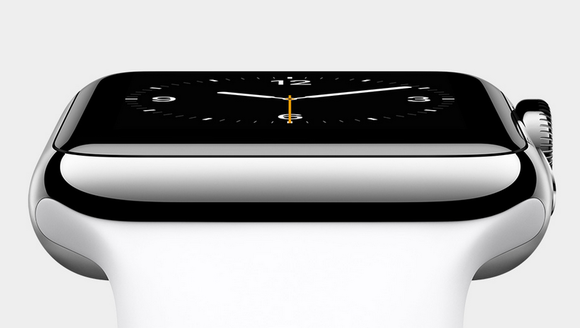
Its new watch may be the most personal device Apple has ever made, but it’s also the most luxurious. Mac fans have always awarded extra points for good design, but with Apple Watch, Apple is appealing directly to people’s sense of style in a whole new way. While the smartwatches from Samsung, Motorola, and LG look like gadgets, the Apple Watch is jewelry.
apple watch crown
Take away its smarts, and Apple Watch can still hold its own against the Breitlings and Cartiers of the world. Apple has crafted two sizes out of six materials and then upped the ante with 22 interchangeable bands, sporty to swanky. That leads to a wide variety of combinations, and likely an equally wide price range. John Gruber recently speculated that the highest-end 18K gold model could sell for upwards of $9,999. If he’s right, that could make it the most expensive product in Apple’s catalogue, since a fully maxed-out Mac Pro is a hair under 10 grand too.
That’s not just a new category, it’s a whole new philosophy, one that fits more on the runways of Milan than the halls of CES. Apple isn’t just selling a smartwatch. It’s selling a fashion accessory that happens to have a Bluetooth LTE chip.
Going vogue
With the iMac, Apple showed the world that personal computers could make a statement. The gold iPhone 5s injected a class shade into the usual color array. The Beats Music purchase brought a hip headphone brand under its umbrella. But make no mistake: Apple Watch is a full-on entrance into the world of fashion.
apple watch heartbeat
And it should be a great fit. The luxury watch market might not be as big as the smartphone one, but there’s more than enough room for Apple to make its mark. With its sleek enclosure and digital crown, Apple Watch is as striking on the outside as a Bulgari Endurer or Franck Muller Vanguard, but its customizable face and interchangeable bands make it unlike any of its peers (and no, I don’t count Samsung’s Gear watches among them). Assuming developers write plenty of apps for it, and Apple adds features with updates, the watch could adapt to the times as quickly as it does to your outfit. But that’s actually a point for dumb watches too—after all, you can keep a Rolex forever without worrying when the company will stop providing OS updates for it.
While we don’t know much about the Apple Watch’s specs, this time it really doesn’t matter—its looks and the experiences it can provide are what’s going to really count. Besides a fancy way to tell time, it can serve as a wearable link to your iPhone, a sensor-laden fitness tracker, and a new way to interact with your friends. But even when it’s not doing any of those things, it’ll still look darn good on your wrist.
In addition to the release of Windows 8.1, Microsoft today launched Microsoft Remote Desktop for Android and iOS, bringing the Windows desktop to phones and tablets. You can download the free app now directly from Google Play and Apple’s App Store.
As its name implies, the app lets you can connect to a remote PC while on the go. This is mainly aimed at business users looking to get their work done from wherever they are, but you can use the Remote Desktop client for your own purposes.
Here’s the official feature list for both Android and iOS:
Access to remote resources through the Remote Desktop Gateway.
Rich multi-touch experience with remote desktop protocol (RDP) and RemoteFX supporting Windows gestures.
Secure connection to your data and applications with breakthrough Network Layer Authentication (NLA) technology.
Simple management of all remote connections from the connection center.
High quality video and sound streaming with improved compression and bandwidth usage.
Interestingly, the iOS app has an extra bullet point: “Easy connection to external monitors or projectors for presentations.” It’s not clear if the Android app is missing this feature and will be added in a subsequent update, or if it’s just not listed.
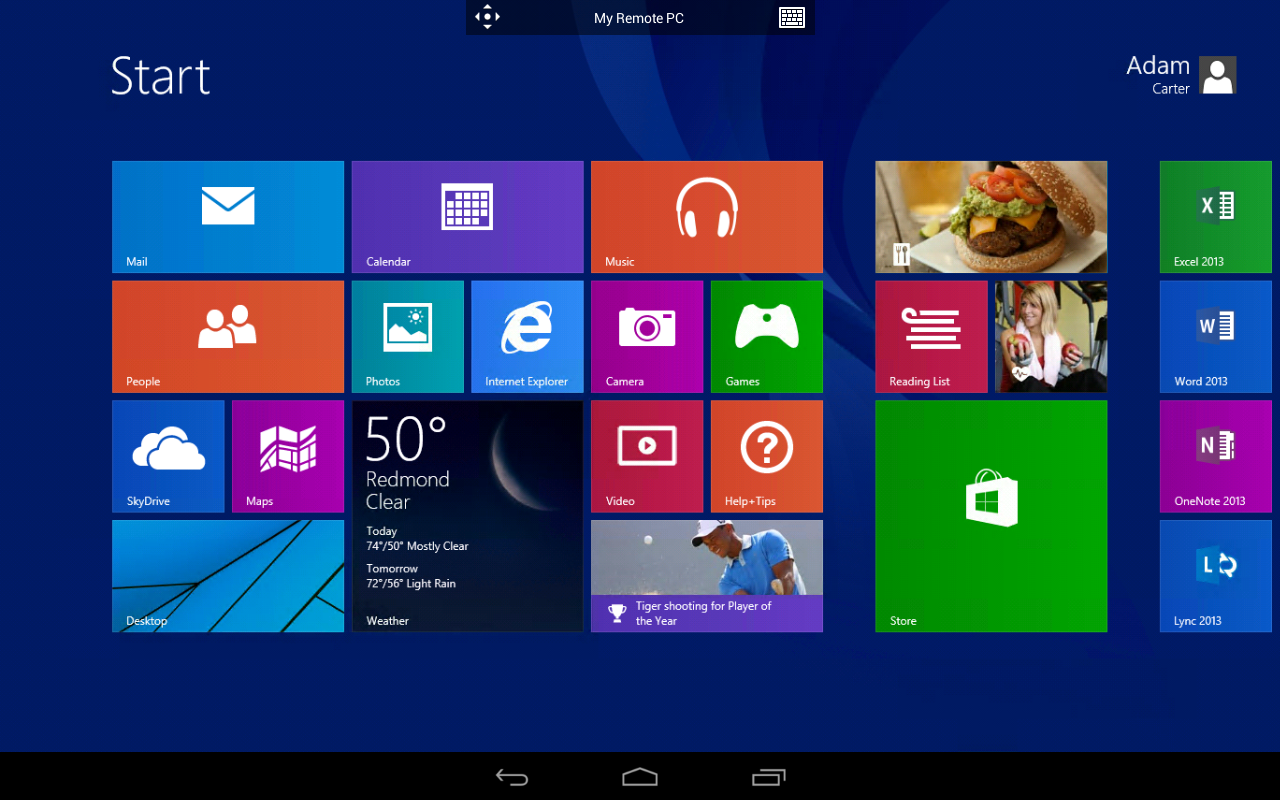
Here’s the Android app showing the Windows 8 desktop:
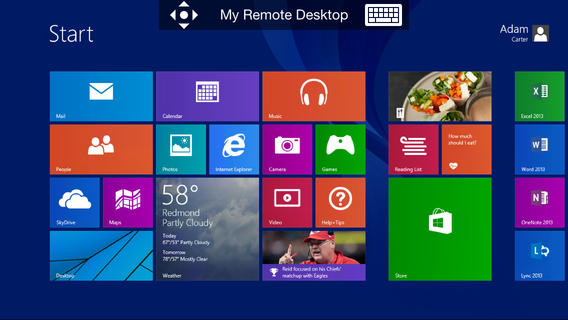
Here’s the iOS app in the same view:
If you need something on your Windows desktop but aren’t nearby, this app is for you (unless, as crazy as it sounds, you’re using a Windows Phone). Microsoft has offered remote access to Windows PCs and Macs for years, but this is the first time the functionality is available to mobile devices that aren’t running one of its operating systems.
The Windows PC that you want to access will need to also be running Remote Desktop, but as a host. You can read more about setting that up on Microsoft.com.
Last week, Microsoft quietly announced the app was coming to Android and iOS sometime this month. The news was slipped in as a one-sentence mention, buried in a press release.
At the time of writing, Microsoft hasn’t made an announcement the apps are available. Clearly the company doesn’t want to promote the release of Remote Desktop on non-Microsoft platforms.
Apple has updated its entire iMac line of products with Intel's latest quad-core processors, new graphics, next-gen Wi-Fi and faster PCIe flash storage.
The 21.5-inch iMac now starts with a 2.7GHz, quad-core Intel Core i5 processor and new Iris Pro graphics. The 21.5-inch is also available with an i5 processor with up to 3.4GHz and Nvidia GeForce 700 series graphics.
SEE ALSO: Apple iPhone 5S: A Great Phone Inches Toward Perfection
The 27-inch model comes with a 3.2GHz quad-core processor and Nvidia GeForce 700 graphics or a 3.4GHz CPU.
Users can also purchase the 3.5GHz processor and Nvidia GeForce GTX 780M series graphics with up to 4GB of video memory.
All iMacs now support the 802.11ac Wi-Fi standard and start with 8GB of memory and a 1TB hard drive. They can be upgraded to up to 32GB of memory and a hard drive with up to 3TB of storage.
The cheapest 21.5-inch iMac costs $1,299, while the model with a 2.9GHz processor and Nvidia GeForce GT 750M graphics will set you back $1,499.
The 27-inch iMac with a 3.2 GHz quad-core Intel Core i5 CPU and an Nvidia GeForce GTX 755M graphics card goes for $1,799; the version with a 3.4 GHz CPU costs $1,999. (
CN/SG)
Apple has released a firmware update for its MacBook Air systems, which addresses a problem with the SSD drives on these systems that could lead to data loss. Apple apparently issued a small batch of faulty drives with its mid-2012 MacBook Air, and this firmware update should correct the problem.
The update should be available via Software Update for relevant systems, and being that this addresses a potential data loss issue, this update is highly recommended. If you do not see the update available in Software Update, but believe your system is an affected one (mid-2012 MacBook Air), then you can download the update from the Apple Support Web site and run it manually.
When you run the update manually, it will test your system to determine if the update is needed, and then apply it if the faulty SSD is found. If your system does not need the update, then the updater will not continue installing.
If the updater cannot update your drive, then on its update page Apple claims you can make an appointment to have the SSD replaced, free of charge. The firmware update is a small 2.21MB download, and requires OS X 10.7.5 or OS X 10.8.3 or later to install. As always, be sure to fully back up your system before applying this update, and also be sure to plug your system into a reliable AC power outlet and follow the on-screen instructions for applying the update. Firmware updates sometimes require the system to restart at least a couple of times, and there may be a significant pause between automatic restarts of the system, so be sure to allow the updater to run its course uninterrupted. (
CNT/SG)